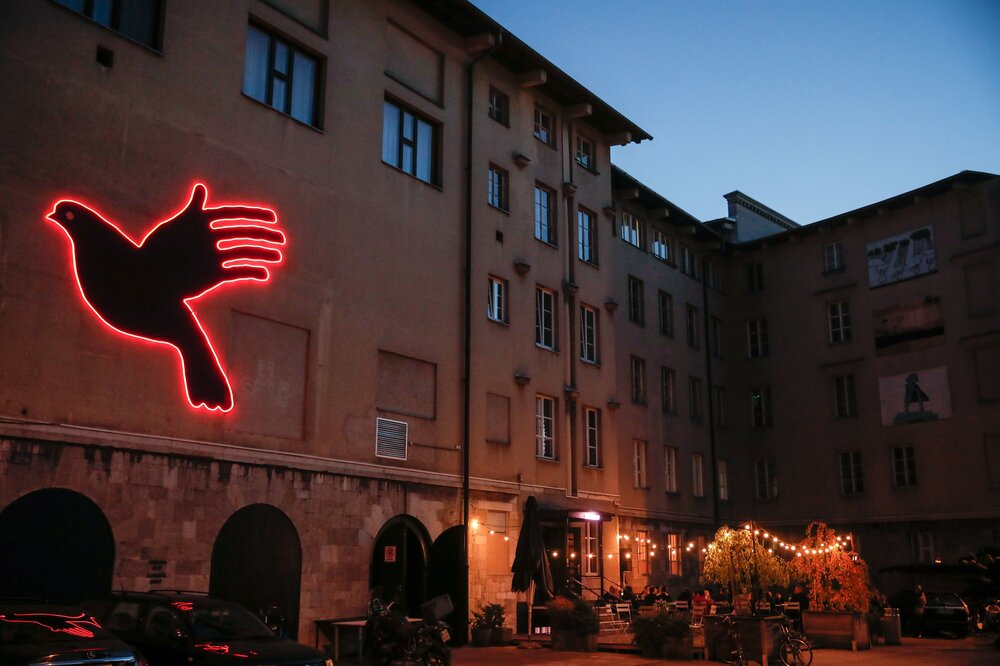
»Between 1955 and the late 1970s, Mladinsko Theatre, literally Slovenian Youth Theatre (Slovensko mladinsko gledališče), had been a public theatre institution founded by the Municipality of Ljubljana in line with socialist theatres for children and teenagers. In the late 1970s, its new artistic director, Dušan Jovanović, transformed it into a daring theatre experiment, with pieces for youth that would attract audiences of all ages, and performances with a politically charged profile. As part of Ljubiša Ristić’s federal theatre project called KPGT (initials constructed from the words for theatre in different South-Slavic languages of Yugoslavia), Mladinsko grew into the first international theatre brand from the late period of socialist Yugoslavia with an extensive international touring programme by the end of the 1980s.
One of the key elements of Mladinsko’s aesthetic reform was the introduction of choreography into theatre-making in the late 1970s and throughout the 1980s and 1990s, with some key figures. Ksenija Hribar’s involvement in the developments of British contemporary dance (a member of London Contemporary Dance Theatre, 1967–1974), with her unprecedented insights into the wide aesthetic range of contemporary choreography and her personal interest in dance theatre very thoroughly impacted the work of Dušan Jovanović, initially in A Vegetable Night’s Dream (Sen zelenjavne noči, 1978) for which the choreographer was awarded the prize for choreography at the Maribor Theatre Festival (Borštnikovo srečanje). Continuing her work with Jovanović, her collaboration extended to performances by Janez Pipan and especially Vito Taufer for whom she conceived two feature-length choreographies, I Am Not Myself I and II (Jaz nisem jaz, both from 1983) with a mixed cast from Mladinsko Theatre, Dance Theatre Ljubljana, and the collective SRP. Nada Kokotović’s choreo-theatrical imagination fundamentally restructured some works of Ljubiša Ristić in Mladinsko Theatre, among which the threepart structure of Romeo + Juliet. Comments (Romeo + Julija. Komentarji, 1983) had a middle part staged as a sheer choreography with no speech. Marko Mlačnik, an actor in Mladinsko Theatre, engaged also with Dance Theatre Ljubljana, implemented a self-invented version of bio-kinetics into the changing theatre formations of Neue Slowenische Kunst and the Post-gravitation Art of Dragan Živadinov in three pieces staged for Mladinsko Theatre: Drama Observatory Zenit (1988) by Cosmokinetic Theatre Red Pilot (Rdeči pilot), 1:10.000.000 (1995), and 1:1 (1995) by Cosmokinetic Cabinet Noordung, all three directed by Dragan Živadinov. Mlačnik’s immense choreographic innovation is present also in Taufer’s Silence Silence Silence (1996), a poetic collage of dreamy theatrical imagery appearing in a womb of a silent creature. Another fruitful collaboration developed between director Tomaž Pandur and choreographer Maja Milenović Workman in the seminal and immensely successful Scheherazade (1989), an east-west opera, for which Milenović Workman developed a series of unearthly gestural compositions for different characters.«
From Nika Arhar, Jasmina Založnik (ed.), Bodies ofm Dance, Aspects of Dance as Cultural, Political, and Art Work in Yugoslavia and After (Belgrade, 2024)