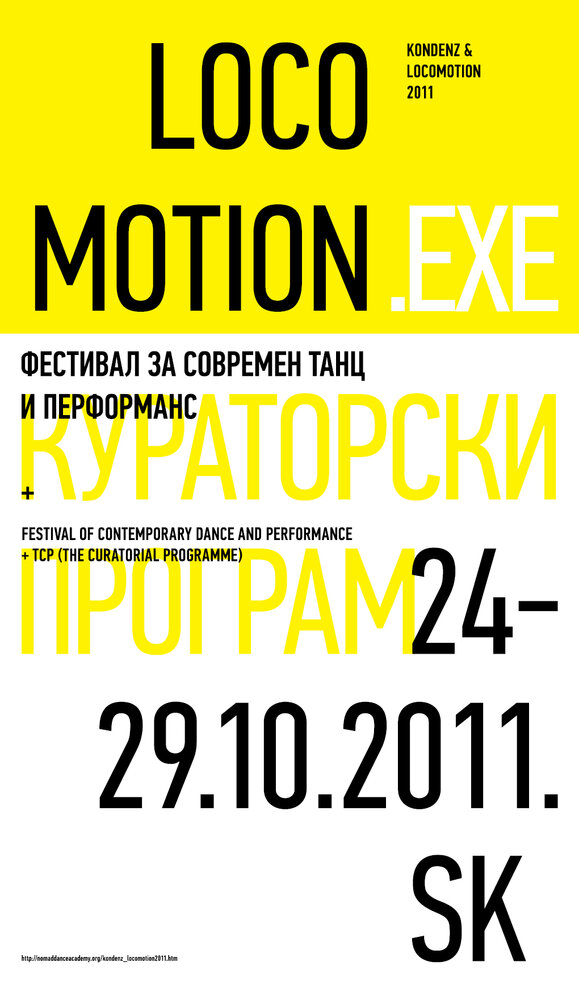
Locomotion, Skopje and Kondenz, Belgrade, October 2011
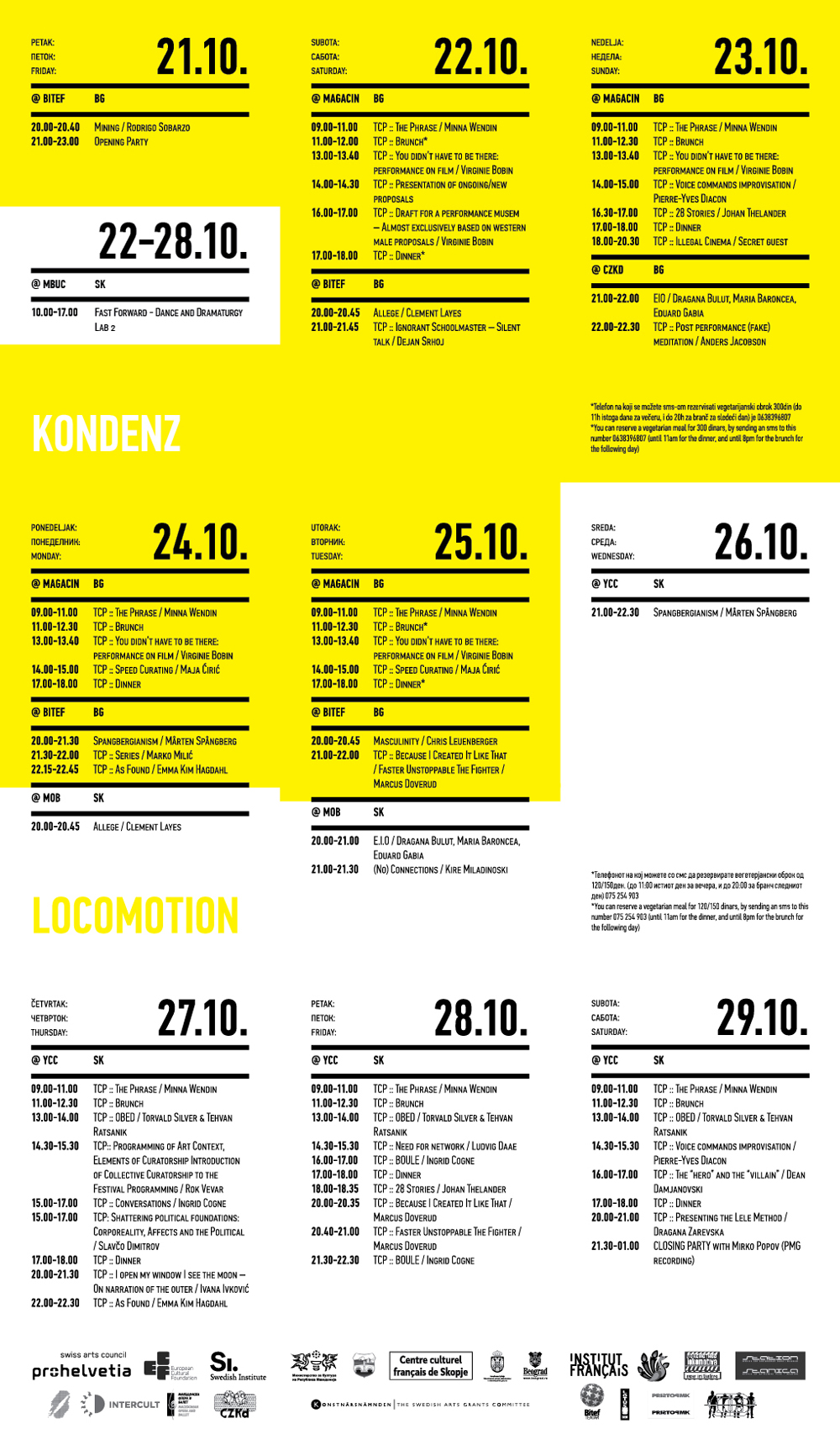
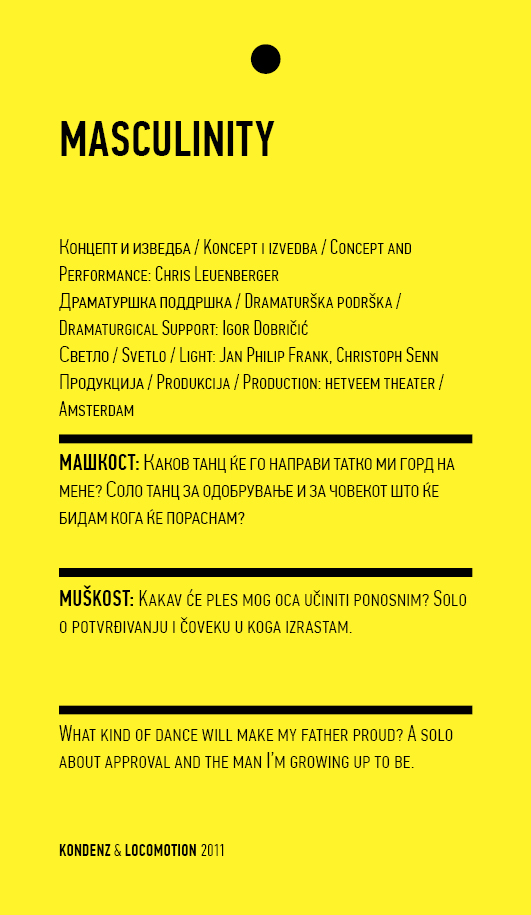
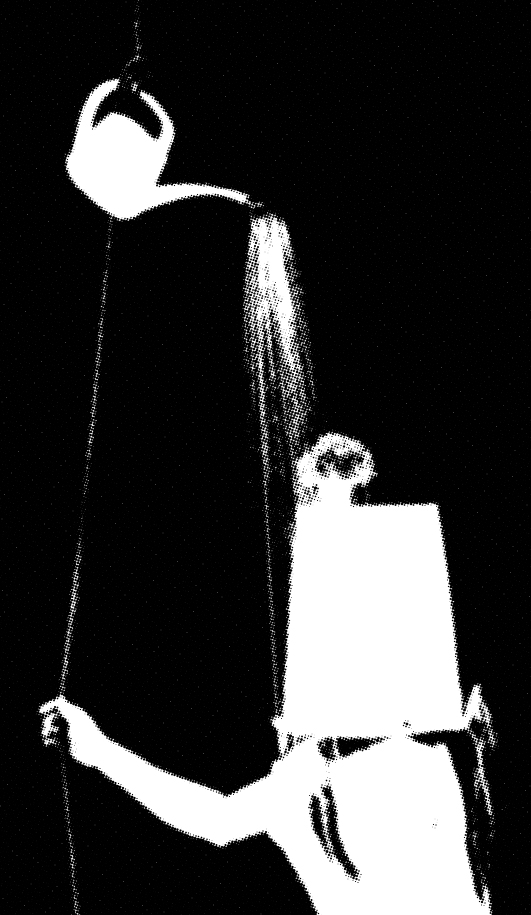
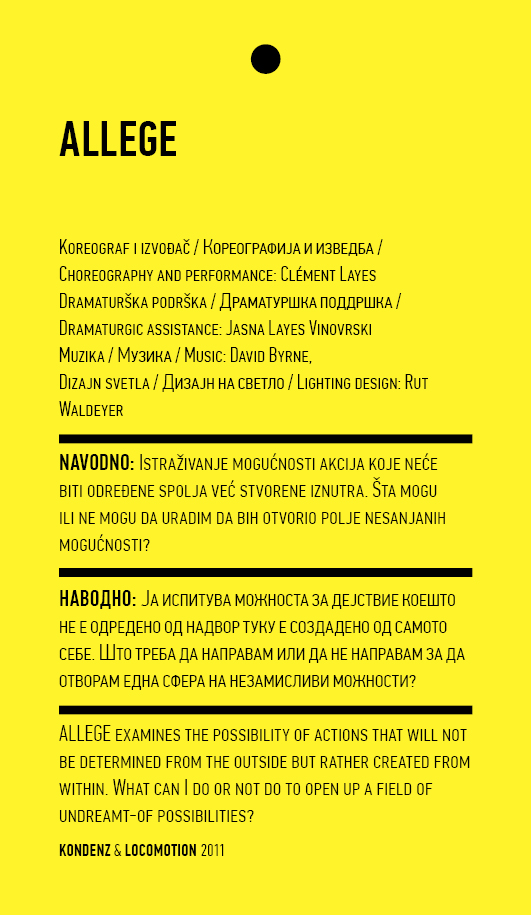
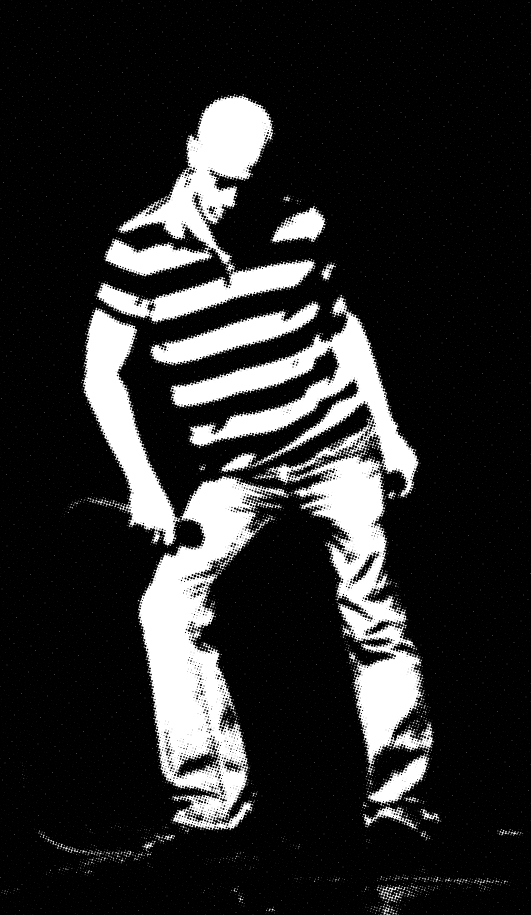
Four years ago, the Station Service for Contemporary Dance and the Lokomotiva Centre for New Initiatives in Arts and Culture founded two regional festivals: the Kondenz in Belgrade and the Locomotion in Skopje. Both festivals were formed under the auspices of the Nomad Dance Academy network with the aim to present the latest, most innovative works by choreographers from the region and beyond. The goal is to familiarise our local audiences with different aspects of contemporary dance and performance. Festivals can be seen as ephemeral venues that can both appear and disappear rather quickly. We realise that nowadays artists travel and present their work all over the world, without being able to affect local contexts, to engage in exchange, to learn, or even to acquire experience. Under the logic of neoliberal capitalism festivals have become venues for marketing artistic work, with little to offer in terms of their social, educational, and developmental value and without fostering exchange, intervention, or generation of knowledge. Therefore, this year we have decided to realise the programme in a different way, dedicating most of it to an attempt to alleviate those lacks. We have decided to join the two festivals together and open up more space for communicating with the audience, offering a programme that will challenge the borders between authorities, space, the audience, performers, programmers, territories, and festivals. Sharing their responsibilities in curating and organisation and in collaboration with Hybris Konstproduktion from Sweden, Kondenz and Locomotion devised a part of their respective programmes together and named it “The Curatorial Programme”. Both festivals feature pre-selected programmes consisting of several performances. Kondenz invited four performances by authors active in the European context: Rodrigo Sobarzo, Clément Layes, Dragana Bulut, Maria Baroncea, Eduard Gabia, and Chris Leuenberger; Locomotion also invited four performances, by Clément Layes, Dragana Bulut, Maria Baroncea, Eduard Gabia, Torvald Silver, Tehvan Ratsanik, Kire Miladinovski, and Aleksandra Kočovska. “The Curatorial Programme” consists of proposals by a pool of participants, artists, theorists, and organisers working in the field of contemporary performing arts, from a number of countries, including Macedonia, Serbia, Croatia, Slovenia, Romania, Sweden, France, and Switzerland, among others. The Curatorial Programme was developed by means of a different festival methodology: rather than inviting a selection of specific performances, our team of curators invited a set of artists, theorists, and organisers. The selected participants were then asked to propose and co-create the programme with the curating team, bringing different approaches to work creativity, knowledge, aesthetics, etc. Also, they will be present for the duration of the festival and the Curatorial Programme. The idea is to give the participants a chance to meet their audience, so that together we may try and reconstruct the notion of the festival and spend quality time together. Also, we hope that this will result in producing new fields of interest and knowledge, in exchanging information, sharing, learning about the differences and similarities among various methodologies of creativity, contextual circumstances, and logic.
How Does the Curatorial Programme Deal with Curating?
Introduction
Kondenz, Belgrade and LocoMotion, Skopje are two festivals dedicated to contemporary dance and the performing arts. They were both launched in 2008, in response to a challenge we had been encountering for some time – the gap between big and market-oriented local festivals of the performing arts and local contemporary performing arts communities. We started by presenting smaller, new, and different works, and inviting our audiences to learn about the state of the performing arts today, as seen by the festival programmers. This year, we want to broach the issues of co-curating, of giving a different kind of space to our colleagues, a selection of practitioners working in different contexts, to come and propose what they would like to do and how they would like to do it.
Background / context
This year, an underlying interest of both festivals concerns the issue of selecting and organising in the performing arts; in other words, curating (which used to be called programming). Curating in contemporary performing arts has been increasingly discussed over the last five to ten years, lately also in publications (e.g. Frakcija, No. 55: Curating Performing Arts, summer 2010), conferences (e.g. Beyond Curating: Strategies of Knowledge Transfer in Dance, Performance and Visual Arts, Essen, Germany, January 2011), workshops (e.g. Towards Curating as a Critical Practice, Novi Sad, Serbia, April 2011), and festivals (e.g. Pleskavica, Ljubljana, Slovenia, June 2011).
How do we define curating?
Originally, curating was a term used in the visual arts for the activity of selecting and organising museum collections into exhibitions. Today, both the term and the field of knowledge have expanded to include everything, from fundraising and engaging in cultural politics to commissioning new and contextualising existing artworks, producing discourse around them, designing how spectators experience the artistic space, and even how they perform. The boundaries between the respective roles of the curator, performer, choreographer, manager, critic, audience member, and theorist have shifted and lost much of their former clarity. We are interested in grasping the functions of these roles and understanding by doing what curating could mean for us, in these very contexts.
Why do we want to work on this?
We believe that discussing curating, in which artistic, economic, and political practices all intersect, is important, allowing further investigation and elaboration. Just how we invite, select, distribute, and finance different artistic proposals, how we make them relate to one another and present them to an audience under the conditions of an increasingly globalised market, can make a fundamental impact on deciding what kind of art to produce and what kind of artistic and intellectual discourses and communities to nurture; not to mention deciding whether a particular artistic proposal can meet the audience of a certain local context and what this meeting may produce. Artistic choices of this kind, and thus also the results of any curatorial practice, are deeply entangled with, and framed by, the parameters of time, money, collective processes, and cultural clashes.
The urge to set up a programme that will address the problems of curating came to us because we wanted to experiment with different ways of organising and presenting a festival in collaboration. On the one hand, most festivals put emphasis on showing works by a few established or emerging artists. Festivals thus often promote homogenisation and commercialisation in the distribution of art. On the other hand, the need for artistic, process-based experimentation regarding more conventional and market-oriented formats of displaying and networking in art has spawned a proliferation of open-framed formats, most of which are quite exclusive to the artistic community.
For this year’s Kondenz and LocoMotion, we hope to find interesting balances, differences, and translations, by combining different, context-dependent modes of curating. We would like to see both festivals become a place where one can meet and act with others, as well as an open space where audiences will always be welcome.
Modes of selection – The Curatorial Programme
To make this possible, we have invited a selection of performances/pieces that we find particularly interesting and important to share in our respective local contexts. In addition to this, we have initiated what we call The Curatorial Programme, with a group of fifteen specially invited artists, theorists, and curators from Western Europe and the Balkans, thinkers who can offer, we believe, interesting combinations of artistic and discursive practices and experiences, as well as relations to the problems of curating. They are invited to act as co-curators, that is, to submit proposals, pieces, practices, situations, discussions, games, meals, reading sessions, etc. The proposals may be individual or collective, existing or new or emerging. The purpose of this format is to create a space that will be nurturing both for the artistic communities and the public, as well as for the discourses that we are developing together, on what the performing arts could do and become. All events in The Curatorial Programme are free of charge (marked TCP in the schedule).
Dear members of the audience,
A warm welcome to you all to attend all the events of both festivals, those that you can read about in this programme, as well as spontaneous initiatives.
The core co-curating team
Dalija Aćin (SRB)
Dragana Alfirević (SRB/SI)
Marijana Cvetković Marković (SRB)
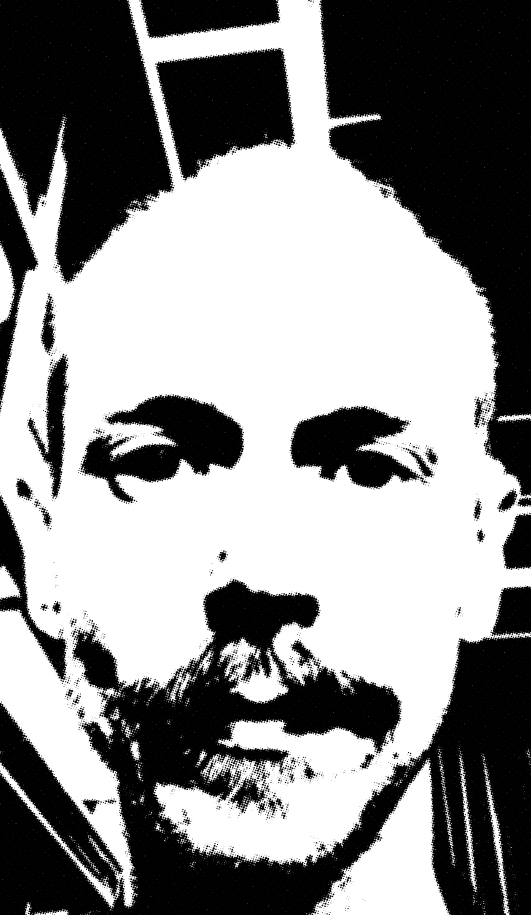
Anders Jacobson (SE)
Iskra Šukarova (MK)
Biljana Tanurovska-Kjulavkovski (MK)
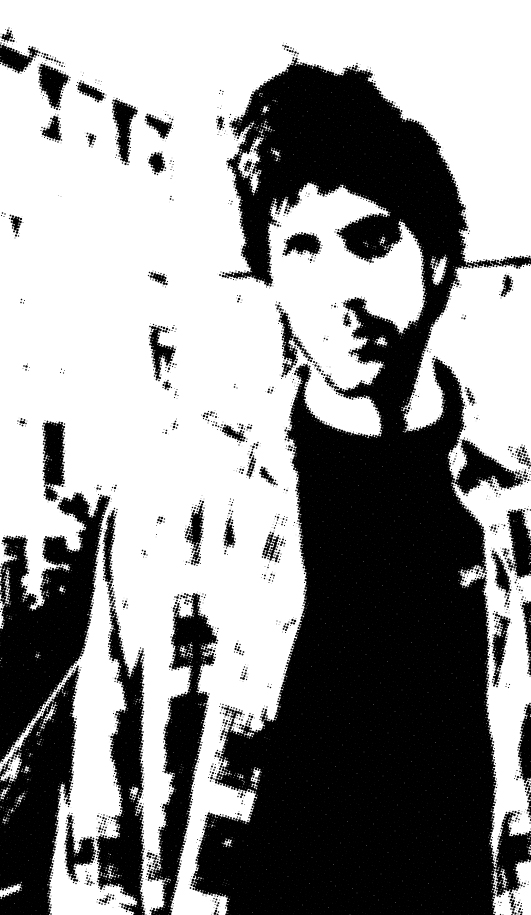
Johan Thelander (SE)