Balkan Fresco
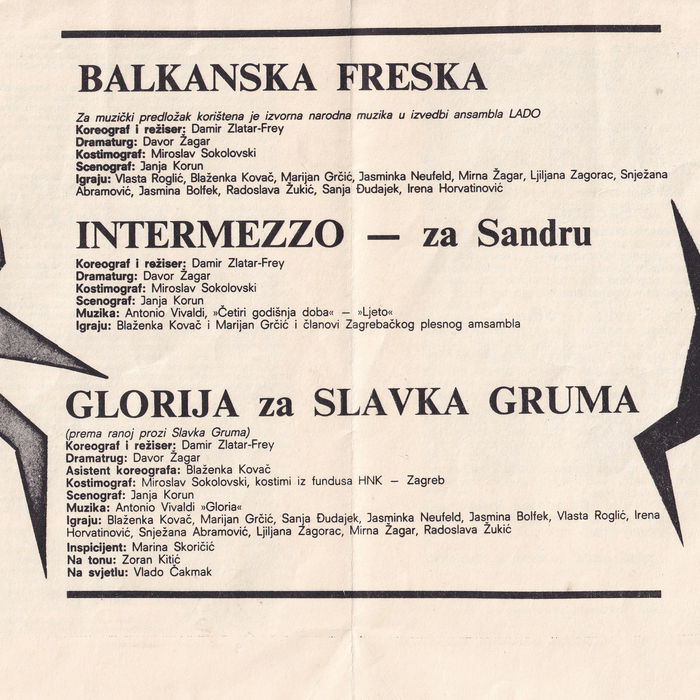
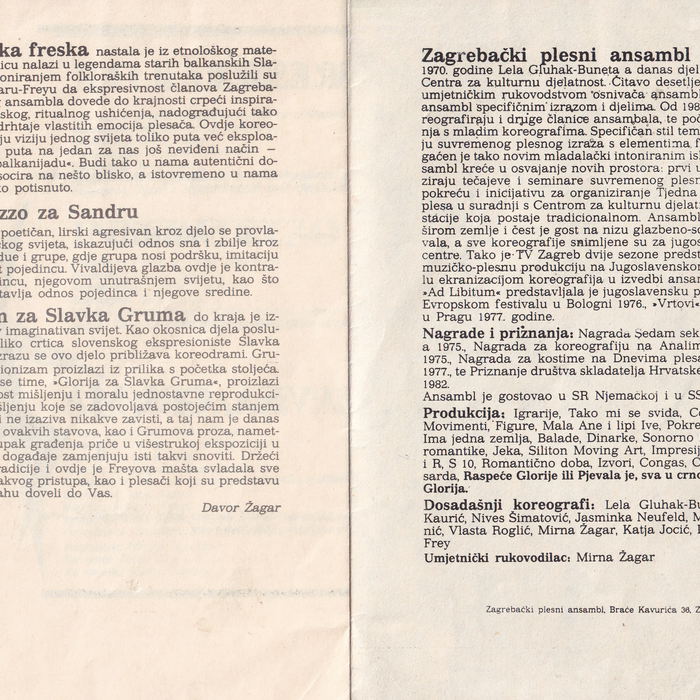
Balkan Fresco arose from ethnological material whose structural core lies in the legends of the ancient Balkan Slavs. By transposing folkloric motifs, Damir Zlatar-Frey uses them to push the expressiveness of the members of the Zagreb Dance Ensemble to its limits, drawing inspiration from pagan, ritualistic ecstasy and further shaping movement through the tremors of the dancers’ own emotions. Here the choreographer offers his vision of a world that has already been exploited many times, but this time in a way not yet seen by us—through his own “Balkan epic.” In doing so, he awakens in us an authentic experience that evokes something familiar, yet at the same time something deeply repressed within all of us.
Intermezzo for Sandra
Dramatic, poetic, and lyrically aggressive, the work is permeated by threads of a oneiric world, expressing the relationship between dream and reality through the relationship between the individual and the group. The group provides support, imitation, or opposition to the individual. Vivaldi’s music functions here as a counterpoint to the individual and to their inner world, just as the group represents the relationship between the individual and their environment.
Gloria for Slavko Grum
With Gloria for Slavko Grum, Frey’s imaginative world finds its fullest expression. The structural basis of the work is formed by several fragments from the prose of the Slovenian expressionist Slavko Grum. In its expressive form, the piece approaches choreodrama. Grum’s expressionism arises from the circumstances of the early twentieth century. Following this orientation, Gloria for Slavko Grum emerges as an opposition to the mindset and morality of simple reproduction—that mindset satisfied with the existing state of affairs, and the morality that provokes no envy, yet which is closest to us today. The combination of these positions, together with Grum’s prose, imposed a narrative structure built through multiple expositions in which real events are replaced by corresponding dreams. Remaining faithful to his own tradition, Frey’s imagination overcame all the obstacles of such an approach, as did the dancers, who brought the performance to you in a single breath.