Nomad Dance Academy (NDA) is an informal contemporary dance network or platform that is active since 2005 in the field of dance education, creation and production, artistic and interdisciplinary research as well as presentation and advocacy. Through its cultural activism it seeks to strengthen the various creative and artistic forces in the local and national contemporary dance contexts of the post-Yugoslav and Balkan region, in order to overcome the challenges connected to local and national cultural politics, improve conditions for professional work, develop new production models, and create an overall dynamic and fluid common cultural space in this part of Europe. The members of NDA consider the work in dance and of dance through the levels of different systemic elements: education, creation, production, research and reception as well as theorization, historicization, and archiving. They understand contemporary choreography as an artistic and social function, methodology, or practice that deals with the (working) conditions of creating, composing, constructing, performing, presenting, perceiving and thinking of various presences, absences, or representations of the human body and its actions (in the individual or collective sense), as well as its traces, indications, and potentialities in the past, present, or future.
Partners of NDA
FOUNDING PARTNERS
Brain Store Project (Sofia, Bulgaria)
Fičo Ballet (Ljubljana, Slovenia)
Lokomotiva – Centre for New Initiatives in Arts and Culture (Skopje, North Macedonia)
Station Service for Contemporary Dance / Stanica Servis za savremeni ples (Belgrade, Serbia)
TALA Dance Center (Zagreb, Croatia)
Tanzelarija (Sarajevo, Bosnia and Hercegovina),
DEVELOPMENT PARTNERS
Nomad Dance Academy Bulgaria (Sofia, Bulgaria)
Nomad Dance Academy Croatia (Zagreb, Croatia)
Nomad Dance Academy Macedonia (Skopje, North Macedonia)
Nomad Dance Academy Slovenia (Ljubljana, Slovenia)
Kino Kultura – Project Space for Contemporary Performing Arts and Culture (Skopje, North Macedonia)
CURRENT PARTNERS
Antisezona (Zagreb, Croatia)
Garage Collective (Sofia, Bulgaria)
Lokomotiva – Centre for New Initiatives in Arts and Culture (Skopje, North Macedonia)
Nomad Dance Academy Croatia (Zagreb, Croatia)
Nomad Dance Academy Slovenia (Ljubljana, Slovenia)
Object of Dance / Objekt plesa (Zagreb, Croatia)
Station Service for Contemporary Dance / Stanica Servis za savremeni ples (Belgrade, Serbia) Tanzfabrik (Berlin, Germany)
Organization of NDA and Working Principles
NDA is a platform of individuals and organizations. It is organized horizontally in order to experiment and sustain an imaginary perspective of creating different options of being and working together. All programmes, collaborations, and exchange were developed through a format of the so-called Decision-Making Body (DMB) consisting of individual members of NDA that together shape its visions, and plan further steps, politics, and actions. Organizations from the region led by some of the DMB members have been used as legal entities through which the actions and programmes have been implemented. Besides the DMB, which took decisions regarding the overall workings of NDA, at certain periods there was the Coordination Office and the Artistic Body, which functioned on a principle of rotation and were dedicated to developing and implementing the agreed upon perspectives. Due to several concerns, among them a possible production of vertical hierarchies, the DMB decided to reshape these bodies and their function into various Task Groups. These are temporary bodies which are formed for taking care of individual tasks on an on-going basis.
The course of the creative, production, and artistic work of NDA, which is organized horizontally and does not envisage a vertical or pyramidal way of decision-making, is enabled by the following principles: the Principle of Balance (including the Rule of Three), the Principle of Invitation and the Principle of Open Space. The Principle of Balance suggests that every artistic and production initiative of NDA should include a consideration of gender, contextual, intercommunal, and partner balance, which should prevent any closing-off and paralysis of interests and knowledge. The Principle of Balance is a principle that fundamentally erodes the inertia of any life and work form of the one (the unit) and presupposes the creative handling of the uncertainty of differences. The Rule of Three, included in this principle, refers to the minimum number of people needed to form a basic creative group or collective, where a third member of the unit provides reflection. The Principle of Invitation replaces the selection method in the work of NDA. An invitation is an affirmative form of selection, with the inviter handling the invitee thoughtfully, sharing the responsibility. The Principle of Open Space is a tool that assumes that not all things or forms of creative life can be predicted in advance. Therefore, with material, temporal, and spatial means, it creates a space for what is not there yet to arrive. In its work, NDA uses a range of improvised or permanent work tools, which transform production, creative, and artistic work into a lively and playful work process.
The Beginning of NDA
NDA was established as the Balkan Dance Network when a group of dance artists, producers and theorists from the former Yugoslavia and Bulgaria first gathered at International Network for Contemporary Performing Arts (IETM) in Belgrade in 2005. With the help of their colleague and friend Nevenka Koprivšek (1959–2021), producer and artistic director, as well as founder of Bunker Institute in Ljubljana, they received a five-thousand-euro grant, which marked the initial push for meetings, discussions, and collaborations. Under the initial name, the diverse Balkan Dance Network exchanges were held in the region in 2005, and an international conference Professional Status of Contemporary Dance in the Balkans was organized in December 2006 in the new cultural centre Magazin in Belgrade by Station Service for Contemporary Dance and Lokomotiva – Centre for New Initiatives in Arts and Culture as partner organizations, opening questions about cultural, political, and aesthetic positions of contemporary dance in the Balkan region, as well as potentials of the Balkan Dance Network for further development and promotion of dance—the potentials that came into existence under the new name of the network in 2007, Nomad Dance Academy (NDA).
NDA Educational Programme, 2008–2010
In 2008, with a grant from the Swiss Cultural Programme for the Western Balkans, the network launched a three-year educational dance and choreography programme under the name NDA Educational Programme which provided groups of regional and international dance artists with a multi-month travelling study programme, which included various theoretical and studio dance practices, organized by partners in different Balkan cities (Sofia, Skopje, Belgrade, Sarajevo, Kanjiža, Zagreb, Ptuj, and Ljubljana). The partners invited some of the most outstanding regional and international dance pedagogues, artists, dance theorists and historians, philosophers and thinkers. Between 2008 and 2010, the educational programme concluded each time with a series of artistic productions and performances which took place at various locations around Ljubljana as the Short Cuts festival (Kratki rezi). During those years, 45 students and their educators created a base for a resilient and tenacious dance community, from which all subsequent NDA projects have developed. In 2013, the Swiss Cultural Programme for the Western Balkans awarded NDA with a prize for the best project.
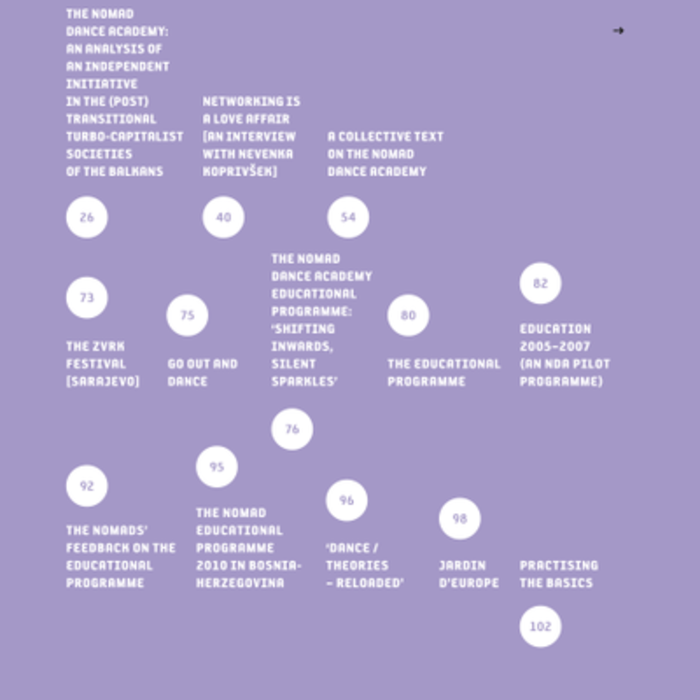
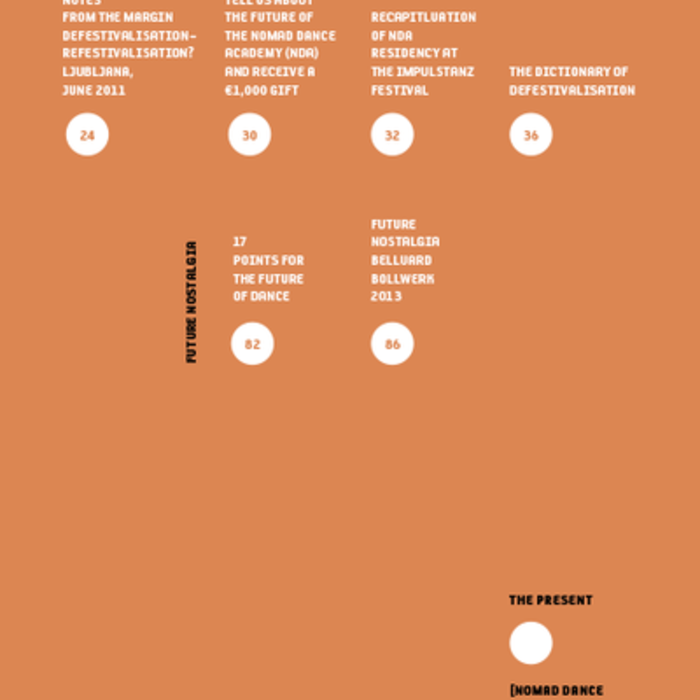
From 2010 until 2011, NDA declared ‘a resting body’ status, dedicating time to reflection and accumulation of materials and ideas for advocating further needs. They worked on a publication during this time, and in July of 2011, the ImPulsTanz – Vienna International Dance Festival invited NDA to a festival residency, where NDA presented, among other things, the publication which summed up its first five years of work. At that time, NDA started to think about diverse advocacy actions as the need for spaces, formal education and sustainable support for dance were not recognized from the policies in most of the republics. Among other initiatives and actions, Go Out and Dance (under the aegis of UNESCO) was inaugurated in 2010 by Goran Bogdanovski, then a member of NDA’s DMB, with an aim to promote contemporary dance and raise its visibility in the cities of the Balkan region on International Dance Day (29th of April). In order to learn more about the development of policies and dance, NDA representatives were invited to visit Stockholm in December 2010 with the support of the Swedish Cultural Institute to see the contemporary dance production conditions in the country and establish contacts with local organizations.
Nomad Dance Institute (NDI), 2011–2019
In February 2011, an NDA Task Group designed a proposal for a new research and education programme, Nomad Dance Institute (NDI), focused on knowledge production. In September 2013, the inaugural meeting of the Institute happened within the frame of CoFestival International Festival of Contemporary Dance at the Museum of Contemporary Art Metelkova in Ljubljana. The new perspective of NDA was All is Education! with which all members wanted to acknowledge that through all of the diverse activities of NDA knowledge is generated and produced as the basis of all processes, practices, and initiatives. At that meeting, each participant— member of NDI had a chance to propose an idea for collaborative joint action that was presented in front of all participants who were able to invite the most engaging ideas to be co-organized and co-financed in the frame of the NDI programme in the future. The invited ideas for which participants had the most interest were supposed to produce knowledge that could be shared with the entire network in different formats and ways. This is how several still ongoing activities were initiated, such as Archiving, the Co-Teaching format, Advocacy Actions (Nomad Dance Advocates), etc.
Nomad Dance Advocates started in 2012 and became a permanent programme of advocating for a more stable position and work conditions in the field of contemporary dance within the Balkan region. Advocacy events take place in various cities throughout the region and gather artists and policy-makers (representatives of ministries of culture, city administrations along with representatives of other decision-making and funding bodies, dance curators and artists) with the intent to enable them to meet directly, communicate (also through the help of performative and less formal communication and discussions, games and artworks), and exchange experiences around the field of contemporary dance and the related policies. Advocacy events have taken place in Skopje (November 2012), Sofia (May 2014), Belgrade (October 2017), Ljubljana (April 2019), and Zagreb (November 2024).
Starting as an idea from the NDI programme, NDA has been developing the programme of Archiving as practice of archiving dance and dance-related practices in the post-Yugoslav region. One of the results is the first digital dance archive of our region that will be launched in November 2024. The (Non)Aligned Dance Archive is intended to be a digital platform for permanent collecting, researching and archiving contemporary dance material from our region. It allows access to hundreds of photos, videos, documents, catalogues, programmes, articles, books, magazines and other material that tell stories about dance: its development, resilience, resistance, collaborations, experiments, and try-outs that have brought us to the current regional dance scenes.
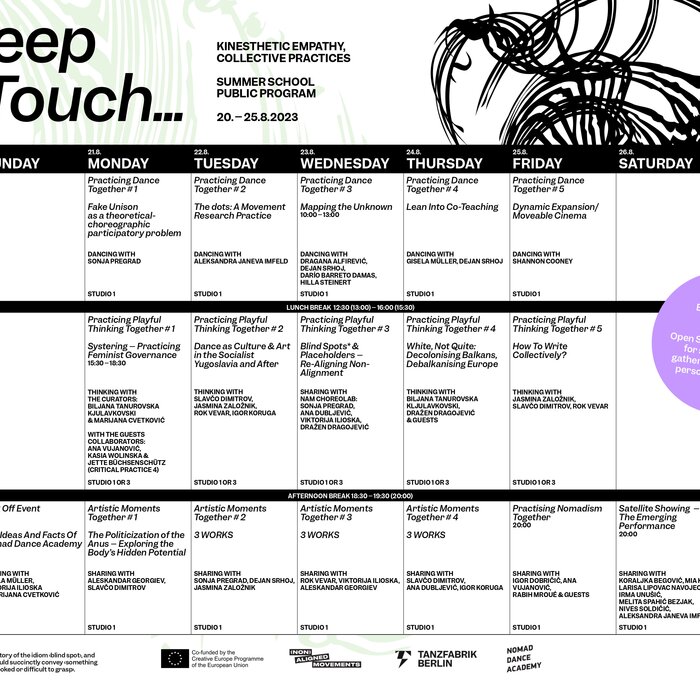
Another important project initiated by NDA and realized since 2013 is the mentoring programme Critical Practice (Made in Yugoslavia). The Critical Practice programme is oriented towards empowering discursive reflections on contemporary performing arts while enabling access for a wider public. In contextual terms, it is focused on but not restricted to the post-Yugoslav region. Among the reasons for such an orientation are, on the one hand, a lack of continual and publicly visible critical writing about contemporary performances and performing arts events in the region and, on the other, the strong recent development in performing arts theory coming from this context. In August of 2017, NDA organized a summer dance school in Ohrid (North Macedonia) under the name Nomad Dance Academy Summer as a space for sharing of diverse knowledge in the field of dance.
In April of 2018, Kino Šiška Centre for Urban Culture as a partner member of the European Dance Network (EDN, now European Dance Development Network), with the help and collaboration of NDA, organized the Encounter Balkans nomadic bus trip to Ljubljana, Zagreb, Belgrade, Skopje, and Sofia. The Encounter Balkans was the first step of the EDN’s extension toward the Western Balkan region and a possibility for producers, curators, and managers from the Western dance houses to get to know the dance scene in the region better. As a result, Station and Lokomotiva joined the network in the following years.
The Festivals of the Partners of NDA, 2008
Already at the beginning of their activity, the partners of NDA committed to the establishment of contemporary dance festivals, which would strengthen the local contemporary dance contexts through their artistic, educational, and advocacy programmes, as well as enabling each partners’ continuation with production, and the strengthening of ties and collaborations in the region and internationally.
Among the partners, an already existing festival was Platforma HR, established in 2000 by TALA Dance Center from Zagreb as the Platform of Young Choreographers.
The festival programme which concluded the yearly educational programme of NDA, entitled Short Cuts (2008–2010), was accompanied with a few other performances in the new Pleskavica festival in 2010 in Ljubljana. After the Anti-festival format of Pleskavica in 2011, the newly established CoFestival International Festival of Contemporary Dance brought together the following festivals in 2012: Ukrep Festival of Dance Perspectives produced by the Ljubljana Dance Theatre (Plesni teater Ljubljana), Pleskavica in the production of Fičo Ballet and NDA Slovenia, and the International Contemporary Dance Programme Modul-dance, created by an international consortium of dance institutions supported by the European Commission with the Culture 2000 programme, which was joined by Kino Šiška Centre for Urban Culture. Today CoFestival is produced jointly by NDA Slovenia and Kino Šiška.
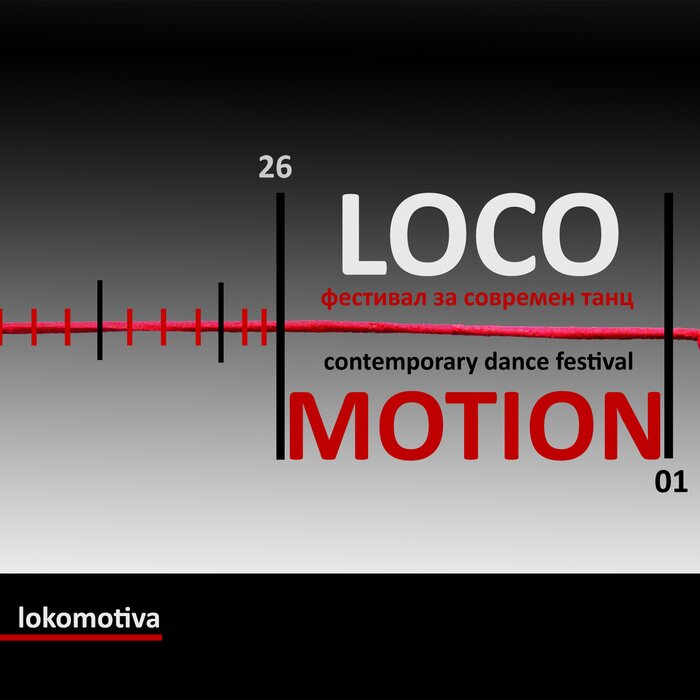
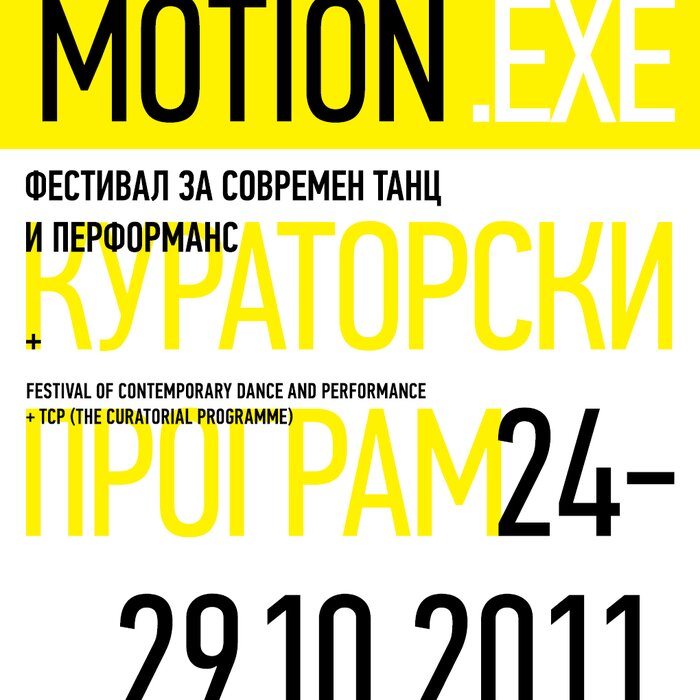
The LocoMotion Festival for Contemporary Dance and Performance in Skopje was founded and created by Lokomotiva between 2008 and 2015. With the opening of Kino Kultura Project Space for Contemporary Performing Arts and Culture (2015–2020) in a former cinema house in the centre of Skopje, the programme of the former festival was transformed into a year-round artistic, cultural, advocacy, and educational programme. Between 2020 and 2023 Lokomotiva initiated a dance programme within the Young Open Theater festival (MOT) and in 2023 established the Performance Platform Festival.
The Kondenz Festival of Contemporary Dance and Performance in Belgrade was founded by Station Service for Contemporary Dance in 2008. It has grown into one of the most relevant performing arts festivals in Serbia with its cutting-edge artistic programme and critical and activist practices of advocating for contemporary dance spaces and policies in Serbia.
The Antistatic International Festival for Contemporary Dance and Performance was founded by Brain Store Project in Sofia in 2008.
The ZVRK Interdisciplinary Art Festival was founded in Sarajevo by Tanzelarija as a Festival of Contemporary Dance Arts, Dance Theatre and Performances in 2008. It was the first of its kind in Bosnia and Hercegovina in the period when Tanzelarija was part of NDA. Due to the large-scale emigration of cultural workers from Bosnia and Hercegovina, the established relationship between NDA and the festival ended in 2010 when Tanzelarija changed its profile.
Current projects
(Non)Aligned Movements (NAM) is the latest NDA large-scale project designed to enhance the creative and collaborative potential of contemporary dance in the Western Balkans. It reinforces the social impact of Balkan contemporary dance by raising its capacities for action and collaboration, promoting its heritage and inscribing it in future discourses and cultural practices.
The NAM project wants to share the experiences of self-organization, horizontal organizational structures, balance, and openness with various dance and performing arts actors. With NAM, NDA is creating the (Non)Aligned Dance Archive to introduce contemporary dance as an important cultural heritage of our region and reinforcing programmes in the region to enable the mobility of dance professionals and to better connect the regional dance festivals. NDA organized the Nomad Summit programmes in Belgrade, Struga, and Berlin as meetings, as well as international school and discursive programmes. Within the project, the network had also invested in a two-year-long research project by NAM ChoreoLab bringing together artists from four different regional countries (Ana Dubljević from Serbia, Viktorija Ilioska from North Macedonia, Dražen Dragojević from Slovenia, and Sonja Pregrad from Croatia) that resulted in the performance essay Such as Rhymes with Non (2024). The research process with public presentations took place in all the partner’s cities, and the performance toured around the region.
Partner networks
Jardin d’Europe 2008–2013
Life Long Burning 2013–2026
Dance On, Pass On, Dream On 2016–2024
DanceMap 2025–2028
The Future to Come
The NDA network has gone through many changes and challenges throughout its two decades, especially regarding its insistence on horizontality in decision-making. Nevertheless, the network and its members are staying open to new challenges, planning on creating certain further shifts and programmes of togetherness in the future. They understand the network as a common space where the members of the network collaborate, discuss, critically (self)reflect, advocate, research, archive, curate, dance, rest, grow together, depart and arrive, moving beyond and forward while enjoying their diverse or agonistic approaches. They perceive it as a self-refreshing organizational model, where the creation of tools and the presentation of contemporary dance is understood as a social practice, an intensive programme for the production and distribution of knowledge, and least but not last, a home.
From Nika Arhar, Jasmina Založnik (ed.), Bodies of Dance, Aspects of Dance as Cultural, Political, and Art Work in Yugoslavia and After (Belgrade, 2024)
NDA Network decided to close in November 2025.